New Personal Investment Accounts: Is There a Better Home for Your €250 a Month?
Ireland’s new Personal Investment Accounts are expected to become available from 1 July 2027, offering people a simpler way to invest and manage the tax associated with it. For those looking to build up their savings and investments over time, the new Personal Investment Account could be a welcome addition.
And it seems there’s already plenty of interest. Research published by Royal London Ireland in September 2026 found that 57% of adults expected to invest up to €250 a month in the proposed Personal Investment Accounts. Of these, 29% anticipated putting away up to €100, while a further 28% expected to invest between €100 and €250.
But while the prospect of opening a Personal Investment Accounts may be appealing, it’s worth considering whether that €250 a month could be put to better use elsewhere.
If you’re paying high interest on debt, have little set aside for emergencies or aren’t saving enough for retirement, these may be areas worth prioritising before thinking about the Personal Investment Account.
Personal Investment Account or rainy day fund: which should come first?
Having a financial cushion can make a considerable difference when life throws up an unexpected expense, whether that’s a car repair, a broken boiler or a period of reduced income.
A good rule of thumb is to aim for enough savings to cover three to six months of essential living expenses, with the money held in an account you can easily access if you need it.
To work out what that looks like for you, start by adding up your regular household expenses, including your mortgage or rent, groceries, utilities, transport, insurance, childcare and any required debt repayments.
For example, if your household’s essential expenses come to €2,500 a month, your emergency savings target would look something like this:
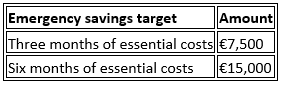
Of course, how much you need will depend on your circumstances. Someone who is self-employed, relies on one household income or has less certainty around their employment may feel more comfortable having a larger amount set aside.
Let’s say you already have €3,000 in savings and want to reach the lower target of €7,500. By putting away €250 a month, you could build up the remaining €4,500 in 18 months, before taking account of any interest earned or withdrawals.
In this situation, building up your emergency savings could be a more sensible immediate priority than investing the same amount. After all, if an unexpected expense arises and you don’t have enough savings to cover it, you could find yourself having to borrow money or sell investments at a time when their value has fallen.
Should you pay down debt before opening a Personal Investment Account?
Another area worth looking at before committing money to the Personal Investment Account is any outstanding debt you may have, particularly credit cards and overdrafts where interest rates can be high.
It’s easy to focus on the potential returns from investing, but it’s also important to consider how much your existing borrowing may be costing you.
Take a credit card balance of €3,000 with an annual interest rate of 20%. If that balance remained unchanged for a year, you could incur approximately €600 in interest, before allowing for fees or compounding.
That’s €600 going towards the cost of borrowing rather than towards your savings or other financial goals.
And while investment returns can rise and fall, interest on outstanding debt will continue to accumulate.
With that in mind, once your essential bills and required repayments are covered, it may make sense to direct any additional money towards your most expensive borrowing first.
That’s not to say you should necessarily pay off your mortgage before considering investing. Mortgage overpayments require a different assessment, taking into account your interest rate, access to cash and any early repayment charges.
The important thing is to understand what your borrowing is costing you and whether reducing that debt could leave you financially better off.
Is your pension on track?
Having a pension is a good starting point, but it’s worth understanding what that pension might provide when you eventually stop working.
Before deciding to direct money into a new Personal Investment Account, there are a few questions worth asking yourself:
- At what age would you ideally like to retire, and how much income would you need?
- What are your existing pensions currently projected to provide?
- How much are you likely to receive from the State Pension?
- Are you making the most of any employer pension contributions available to you?
- Would increasing your monthly contributions help close a potential shortfall?
Let’s consider someone earning €120,000 a year. As an initial planning exercise, they might aim to replace around 50% to 60% of their gross salary in retirement. That would mean targeting an annual retirement income of between €60,000 and €72,000, including their State Pension and any other sources of income.
However, that percentage is only a starting point. Someone who expects to have their mortgage paid off by retirement may need considerably less, while someone hoping to travel extensively or continue supporting family members may need more.
It’s worth thinking about what you actually want your retirement to look like, rather than relying on a percentage of your current salary alone.
The Pensions Authority calculator can help you get an idea of the contributions you may need, based on factors such as your age, planned retirement date, existing pension fund and current contributions.
If your pension is unlikely to provide the income you’re aiming for in retirement, increasing your contributions by €250 a month could be a worthwhile option to explore.
Why can a pension be more tax-efficient?
For someone saving specifically for retirement, one of the main pension advantages is Income Tax relief on qualifying pension contributions.
Let’s return to our example of someone earning €120,000 a year. Assuming they have sufficient income taxed at 40% and enough unused pension contribution allowance, a gross pension contribution of €250 would cost them just €150 after Income Tax relief.
Look at it another way. If they were prepared to reduce their monthly take-home pay by €250, they could potentially contribute approximately €416.67 to their pension each month.
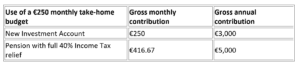
That’s an additional €2,000 going into their pension each year for the same €3,000 reduction in take-home pay, before allowing for charges.
Of course, there are a few important points to bear in mind.
These examples assume the person qualifies for the full 40% Income Tax relief and has sufficient pension contribution allowance available. They compare the amounts being contributed rather than what someone would eventually receive after tax. Employee pension contributions also do not qualify for USC or PRSI relief.
There are limits to how much you can contribute while benefiting from Income Tax relief.
For example, a 45-year-old earning €120,000 can generally claim relief on personal pension contributions of up to 25% of relevant earnings, subject to an earnings cap of €115,000. That means a maximum of €28,750 a year, including existing employee contributions and additional voluntary contributions (AVCs).
It’s important to remember that this is a tax-relief limit, rather than a suggested amount that everyone in that position should contribute.
Pension savings also generally grow free of Irish tax while invested, although charges apply, investment values can fall and withdrawals in retirement are subject to the relevant tax rules.
One of the main considerations, however, is that pension money is generally tied up until retirement.
If you’re saving for something you may need the money for sooner, such as helping a child with college costs, buying a home or another medium-term goal, having access to your investments could be an important factor.
That’s where a new Investment Account may have a role to play, even if a pension offers more generous tax benefits upfront.
Finding the right home for your money
The new accounts could provide another useful option for people who want to invest, particularly those who have already built up emergency savings, are managing their borrowing comfortably and feel confident about their retirement plans.
The key is to consider how an investment account would fit alongside your other financial commitments and goals.
If you’re unsure whether you’re in a position to start investing, the Competition and Consumer Protection Commission (CCPC) has some useful resources.
Its guidance recommends building emergency savings equivalent to three to six months of basic living expenses, while its Investment Readiness Tool can help you assess whether investing is appropriate for your circumstances or whether there are other financial priorities worth addressing first.
You do not necessarily need to maximise pension contributions before investing elsewhere. The right balance depends on your goals, access needs and retirement position.
With the new Investment Accounts expected to arrive next summer, now is a good opportunity to take stock of where you stand financially.
If you’re thinking about putting €100, €200 or €250 a month into one of these accounts, it’s worth looking at your priorities first. You may find that building up your emergency savings, paying down expensive debt or increasing your pension contributions could make better use of that money, at least for now.
At LHK, we can help you work out your emergency savings target, assess your retirement projections and compare how best to use your monthly surplus.
Book a meeting with our financial advisers to put a practical plan in place before the new accounts arrive.